


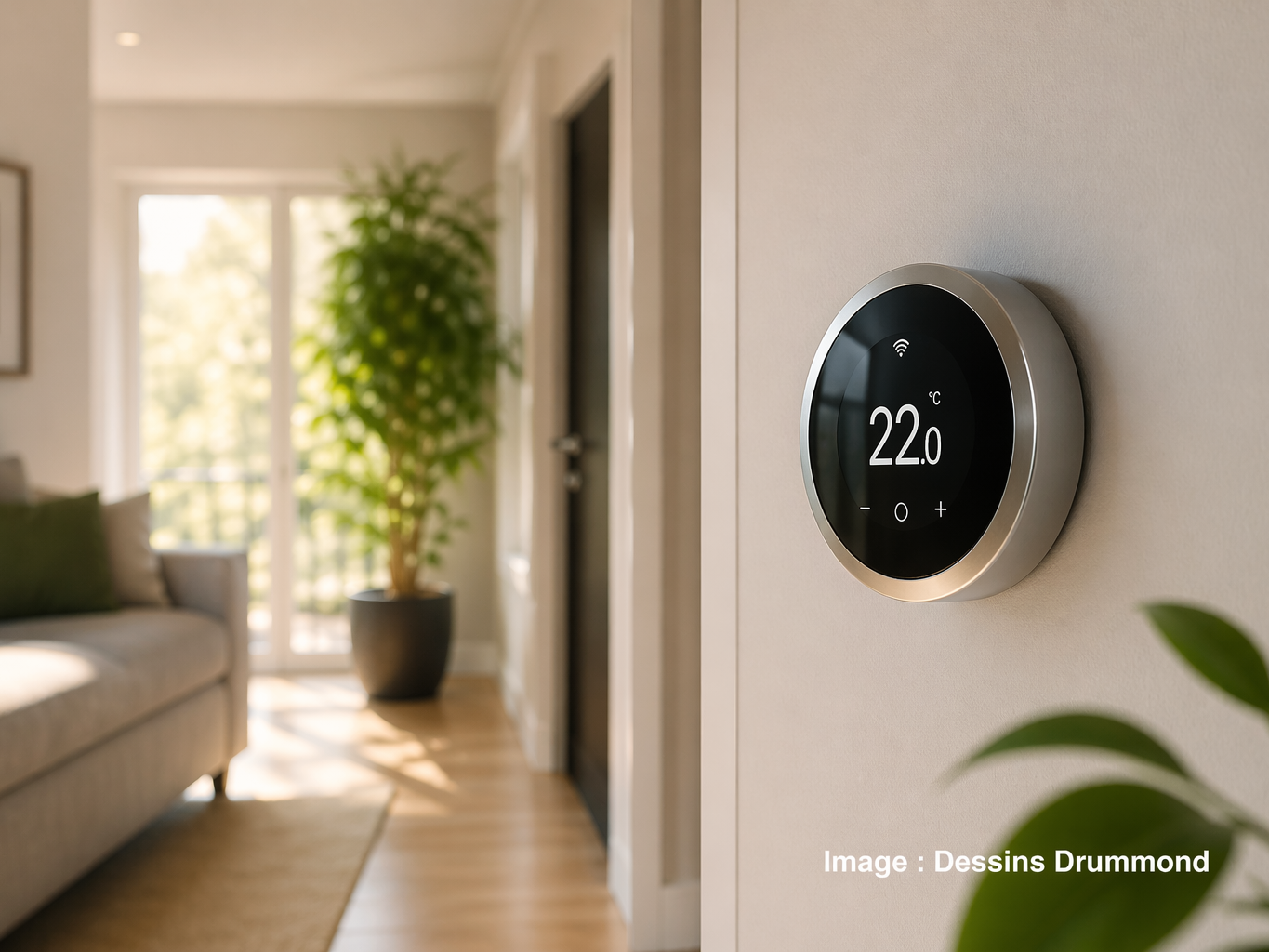
Electronic thermostats reach a more uniform temperature than conventional bi-metallic thermostats. What’s more, their use can save up to 10% on the costs of heating.
Conventional thermostats work thanks to a simple mechanical reaction between the unit and room temperature. This system lacks precision and causes variations of more or less 2 degrees Celsius from the desired temperature, which can mean a difference of up to 4 degrees Celsius.
As for electronic thermostats, they react to the slightest change in room temperature because it is continually measured by a detector. Variations being more or less 0.5 degrees Celsius, the temperature is more stable since the maximum difference does not exceed 1 degree Celsius.
With a programmable thermostat, additional savings can be had if it is adjusted to reduce the temperature automatically at night and while absent. For example, a reduction of 3 degrees Celsius in an 8 hour night brings a reduction of 4.5% of the cost of heating, a small change which can translate into significant savings.
Source: The Guide to Ecological Options, APCHQ
Thanks for your posting. What I want to point out is that when evaluating a good on-line electronics store, look for a web-site with total information on key elements such as the privacy statement, safety details, any payment guidelines, and other terms as well as policies. Generally take time to investigate the help and also FAQ sections to get a greater idea of what sort of shop performs, what they can perform for you, and just how you can make the most of the features.