

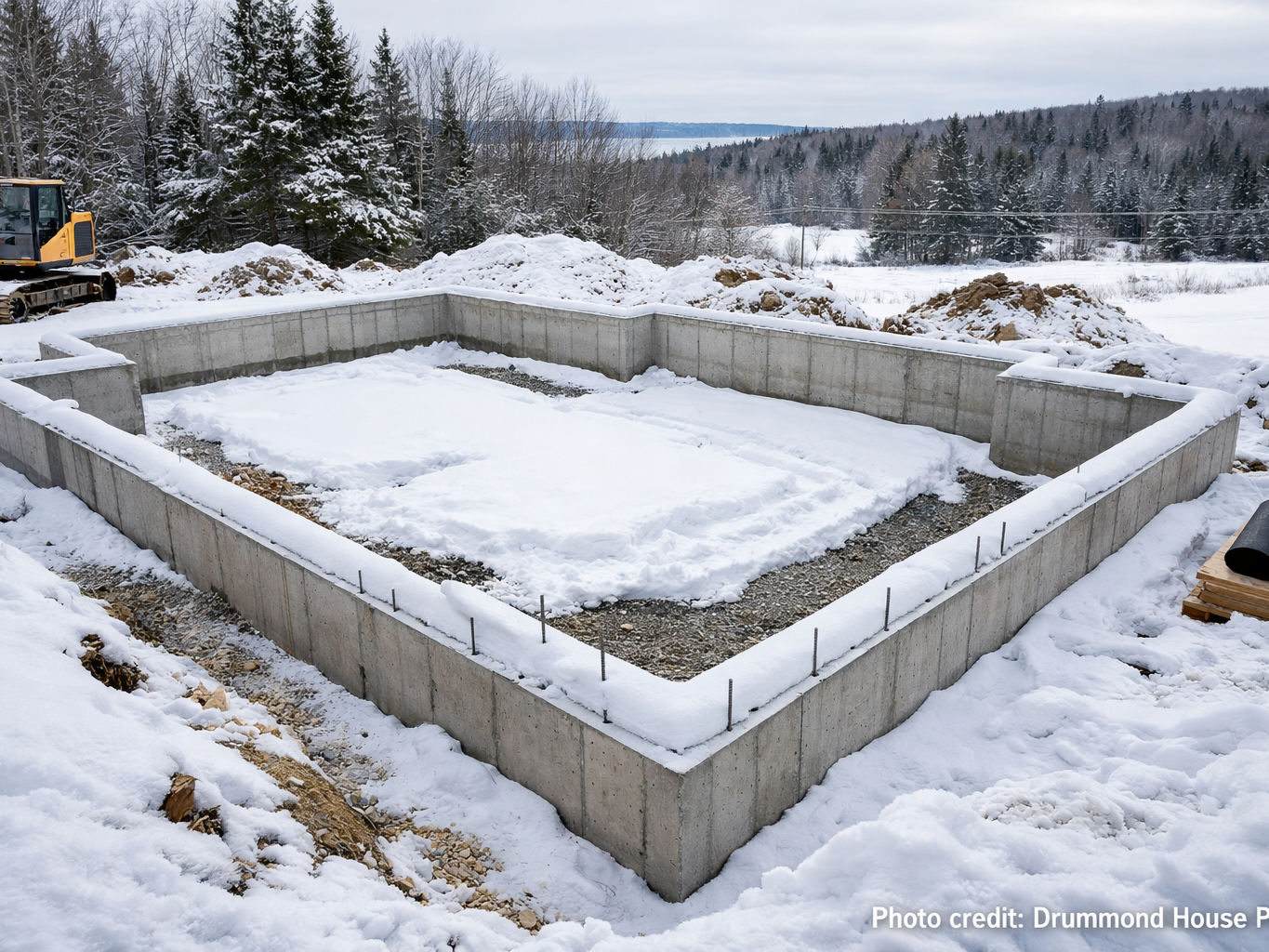
It’s important to ask yourself one key question before moving forward: what is the main reason for pouring a foundation early in the project and leaving it exposed all winter without building on it?
Some contractors choose to proceed this way because their crews move from one project to another and remain active year-round, even during colder months. However, just because it is possible does not always mean it is the best approach for a foundation.
Pouring Foundations Year-Round in Quebec: Is It Safe?
In Quebec, pouring concrete foundations is done 12 months a year. Snow itself is not the primary concern—in fact, it can act as a natural insulating layer.
However, certain precautions are required for a foundation poured in winter:
- Applying a protective membrane on foundation walls helps prevent frost from adhering to the surface
- Proper curing conditions must be maintained despite low temperatures
- Site preparation becomes even more critical to avoid long-term issues
While winter conditions can be managed, the real concern lies in what happens after the foundation is poured.
Risks of Leaving a Foundation Exposed During Winter
The main issue is not the pouring itself, but leaving the structure exposed to freeze-thaw cycles.
- Footings are directly exposed to harsh winter conditions
- Repeated freezing and thawing can affect soil stability and structural integrity
- Movement or shifting may occur before construction continues
According to building code guidelines:
- If the ground floor structure is not yet built, backfill must not exceed 3 ft. 11 in. for 8-inch thick foundation walls
- If the floor structure is completed, backfill can go up to 7 ft. 6 in.
These limitations exist to reduce pressure and instability risks for a foundation left unfinished.
Expert Recommendations: Wait or Proceed?
Organizations such as the Canadian Cement Association do not recommend pouring foundations in the fall if construction will not continue immediately afterward.
Interestingly, even the CMHC does not provide specific technical guidance on this exact scenario, which highlights the importance of caution.
👉 In most cases, the safest and most cost-effective approach is to wait until spring:
- Equipment is mobilized only once
- Construction progresses without interruption
- Risks related to soil movement and frost are minimized
If you still decide to proceed, make sure all protective measures are in place for a foundation to withstand winter conditions—and accept that some level of risk remains.
Final Thoughts
Pouring early might seem efficient, but timing your project properly often leads to better results. When in doubt, consult local professionals—they may offer practical insights or techniques adapted to your region.
And most importantly, take the time to evaluate what truly makes sense for a foundation built to last.